








Free written scope consultation - allowances, timeline, and change-order rules on paper before a single trade is scheduled
Sakrete Kitchen Remodeling: The Austin Owner’s Guide
If you’re mid-remodel with Sakrete products in your Austin kitchen and something’s failing, we can help. The short answer is that Sakrete plays a supporting role in kitchen remodels, not a starring one: their cement-based products (mortar mixes, floor levelers, concrete resurfacing compounds, grout additives) are the structural layer beneath your tile, stone, and cabinets. A typical kitchen remodel in Austin runs $14,000 to $45,000 depending on layout, cabinet line, and countertop material, and we have Sakrete-compatible materials on our trucks most days for repair work.
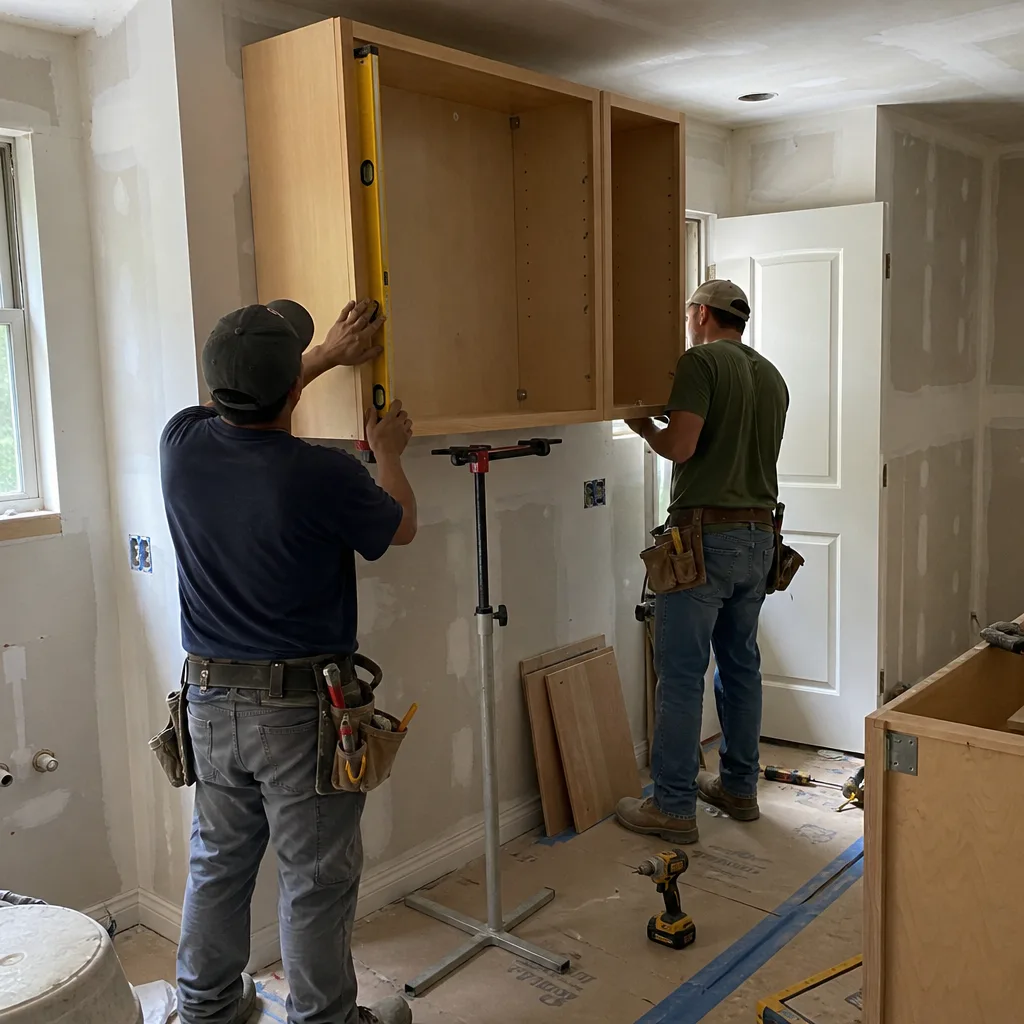
How owners usually discover a problem: a tile has cracked or a floor has sagged, and investigation reveals the mortar bed or leveling layer beneath it failed. Maybe the substrate wasn’t prepped right, maybe water got in, maybe the original mix was over-watered. The visible tile or countertop is rarely the actual culprit. It’s what’s underneath that matters.
Key Takeaways
- Sakrete products are the structural layer beneath kitchen tile, stone, and flooring, not a standalone “part” you swap out.
- Most Sakrete-related failures trace back to water intrusion, improper mixing, or bad substrate prep from the original install.
- Repair costs for the Sakrete layer itself run $800 to $2,500 when it’s a backsplash or mortar-bed issue; full kitchen remodels run $14,000 to $45,000 in Austin.
- We stock Sakrete floor patch, mortar mix, and self-leveling underlayment on our trucks for same-week repair work.
Which Sakrete Models This Applies To

Sakrete isn’t sold in “models” like a dishwasher or a refrigerator. It’s sold in product lines, each engineered for a specific job. In Austin kitchens, the products we most often see fail and replace include:
- Sakrete Sand Mix (sometimes labeled Sand Mix Topping & Bedding) – used for thick mortar beds under tile, shower pans, and kitchen floor builds. This is the product that creates a float bed for tile when the subfloor isn’t level.
- Sakrete Self-Leveling Underlayment – poured over concrete or wood subfloors before tile installation. Common failure point: poured too thin or mixed with cold water, so it cures weak and crumbles.
- Sakrete Floor Mud / Mortar Mix – the dry-pack mortar used for sloped kitchen floors or raised areas. Failure point in older Austin homes: the original mix used too much water, and decades of foot traffic turned it to powder.
- Sakrete Fast Setting Concrete Mix – used when a kitchen slab needs patching or a countertop base needs reinforcing.
What trips up homeowners trying to match a product: Sakrete bag markings don’t always match what’s in your wall or floor, because the labeling has changed over the years. A bag from 2008 might say “Floor Mud” while the current equivalent says “Sand Mix Topping & Bedding.” If you can take a photo of the old product or describe how thick the layer is, that tells us what to bring. We’re an independent contractor, not affiliated with Sakrete, but we install and repair their products every week in Austin.
On the OEM versus aftermarket question: with cementitious products, aftermarket doesn’t really apply the way it does with appliance parts. What matters is cement-to-sand ratio, cure time, and compressive strength. Sakrete products have charts and load ratings printed on each bag. We spec for the job, not the brand label, though Sakrete is what we carry because it’s consistent bag to bag.
Styles & brands we work with







Signs Your Sakrete Kitchen Remodeling Is Failing
- Cracks running through tile in a straight line or zigzag. This almost always means the mortar bed or underlayment beneath the tile has cracked and the tile is just following the crack. The tile itself is fine; the plane below it isn’t. In Austin, clay soil shifting under slab foundations is the usual root cause, and Sakrete products can’t stop a moving foundation. What we can do is repair the layer and isolate it from future movement with uncoupling membranes.
- Hollow-sounding tile when you tap it. A hollow spot means the tile has debonded from the mortar bed. Common causes: the original installer let the mortar skim over before setting tile, or used Sakrete product that was past its bag date. It only gets worse with foot traffic.
- Grout turning to dust around your kitchen island. Grout that’s disintegrating is usually a symptom of flex. The floor underneath moves, the grout can’t flex, so it breaks down. Fixing the grout without addressing the flex means you’ll be redoing it in a year.
- Countertops or cabinets sitting slightly off-level. A level check across the kitchen tells the story. If the floor leveling compound has failed or settled, you’ll see a slope toward the center or a corner dropping. This puts stress on cabinets, pulls countertop seams apart, and creates gaps that collect water.
- Water stains or efflorescence (white powdery residue) creeping up from the floor. That white powder is salt and minerals wicking up through compromised cement. It means water is getting into the Sakrete layer from somewhere: a slab leak, a dishwasher line, or exterior drainage. Until the water source is stopped, any repair is temporary in Texas humidity.
See the difference
 Before
 After
After Before
 After
After Before
 After
AfterReplacement Cost & What’s Included

When the failing part is the Sakrete layer itself (mortar bed, leveling compound, or patching), the typical repair in Austin runs $800 to $2,500 for a focused-area fix like a backsplash substrate, a section of failed floor underlayment, or mortar bed repair before re-tiling. If the entire kitchen floor needs to be taken down to the subfloor, re-leveled, and rebuilt, you’re looking at $10,000 to $28,000 for the structural and finish work combined.
That number goes up or down based on four things: square footage, whether the existing tile needs to be removed and disposed of, the amount of floor leveling compound the low spots demand, and whether your cabinets can stay in place or need to come out. Our written estimate includes material, labor, removal, and disposal. You get one number before we start, and that number is what you pay unless you request a change in scope. Any repair we make carries our 365-Day Done Right Promise: if the Sakrete repair fails within a year, we come back and fix it at no charge, no service call, no re-inspection fee.
For the full kitchen remodel including cabinetry and countertops, Austin pricing runs $14,000 to $45,000. We install KraftMaid and Wellborn cabinetry, plus Cambria, Silestone, and Caesarstone countertops. Each carries its own manufacturer warranty layered on top of our written guarantee. Two protections, one invoice.
DIY or Call Us?
Here’s where I’d draw the line. You can absolutely mix and pour a small Sakrete floor patch yourself if the damaged area is under two square feet. You can also pull up a loose tile, clean out the old mortar, and reset it with a small bag of Sakrete mortar mix from the hardware store. That’s honest weekend work, and the worst that happens is you redo it again.
What you shouldn’t attempt alone: anything involving a large self-leveling pour (multi-bag pours need two people minimum and move fast), any repair where the underlying subfloor is compromised or water-damaged, and any kitchen where the leveling failure is tied to foundation movement. Cement products are heavy, dusty, and unforgiving if mixed wrong. Breathing fine silica dust is a real lung hazard, and we use proper respirators and containment every time. If water is involved, or the repair means standing on anything higher than a step stool, stop and call us.
Tell me what you need, I’ll tell you what it costs, and we’ll go from there. You can reach us at (325) 225-5429 any time. A real person answers, day or night.
FAQs
Twenty to forty years is realistic when it’s installed correctly and kept dry. The Austin wildcard is slab movement: our clay soils expand and contract with drought and rain, and that motion eventually cracks any rigid cement layer. If your home is older and the slab has shifted, the Sakrete layer fails faster through no fault of the product.
Yes, when the failure is localized. A cracked section of underlayment under a few tiles can be chipped out, re-poured with fresh Sakrete product, and re-tiled without touching the rest of the floor. The tricky part is matching the height of the existing layer so the repair doesn’t create a hump. Call (325) 225-5429 and we’ll confirm whether your damage qualifies before quoting.
Most mortar bed patches and small leveling pours cure enough for tile in 24 to 48 hours. A full kitchen floor re-level is a three to five day job including removal, prep, pour, cure time, and re-tiling. We give you a written schedule with your written price, and we show up in the window we committed to.
We stock Sakrete Sand Mix, Self-Leveling Underlayment, Floor Patch, and Fast Setting Concrete Mix on our trucks, along with the primers and bonding agents those products require. You don’t need to source anything. If your project calls for a specialty Sakrete product we don’t carry, we’ll pick it up from our Austin supplier the same week at no extra charge.
Written by Trevor Nash, Owner, Penhallow Remodeling Austin, serving Austin and nearby areas.


