







Free written scope consultation - allowances, timeline, and change-order rules on paper before a single trade is scheduled
Plant Prefab Home Additions & ADU: The Austin Owner’s Guide
If your Plant Prefab addition or ADU is showing signs of real trouble, here’s the straight answer: a full Plant Prefab addition or ADU in Austin typically runs $45,000 – $130,000 installed, depending on size, foundation condition, utility runs, and finish level. We handle these projects start to finish, from site prep through final inspection. Most owners call us after noticing one of a few repeat problems: water intrusion at the panel seams, doors that won’t close square after a season of settling, or electrical issues where the factory-installed panel meets the Austin grid.
What we’ve learned doing this work across Austin neighborhoods like Allandale, Crestview, and Barton Hills is that Plant Prefab homes have a specific set of strengths and a specific set of weak points. The factory build means tight tolerances. It also means that when a site wasn’t prepped perfectly, the margin for error is thinner. We know what to look for because we’ve opened enough of these walls.
Which Plant Prefab Models This Applies To

Plant Prefab builds primarily two construction types that come up in our Austin work: their panelized system and their modular units. The panelized homes arrive as flat-packed wall, floor, and roof panels that get assembled on site. The modular homes arrive as larger, pre-built sections. Each one has a different failure profile in Central Texas clay soil.
Here’s the compatibility gotcha most owners miss: panelized Plant Prefab homes rely on the on-site foundation more than modular ones do. When a panelized addition starts showing cracks at the drywall seams or doors binding, the problem is almost never the panel. It’s the pier-and-beam foundation shifting beneath it, or the slab heaving during our summer dry spells. Austin’s expansive clay shrinks dramatically between June and September, and that movement transfers straight into a panelized structure faster than a stick-built home.
We also see owners try to match aftermarket hardware to Plant Prefab’s factory-installed components. Their window and door rough openings are milled to tighter tolerances than standard Texas framing. A standard off-the-shelf door from a big box store often needs the rough opening reworked because the factory rough-in was cut for their proprietary jamb system. If you’re swapping an exterior door on a Plant Prefab structure, plan on frame modification. We keep common jamb extensions and threshold transitions in our Austin stock because it’s a repeat call.
Styles & brands we work with







Signs Your Plant Prefab Home Additions & ADU Is Failing
- Panel seams opening or cracking at the drywall. This is the most common issue we see from Cedar Park down to Buda. Plant Prefab panels expand slightly with humidity, and when the site foundation isn’t moving in sync, the seam tape cracks. It’s rarely structural, but it’s a sign the foundation needs a look.
- Doors that won’t latch or rub at the top corner. The door hasn’t changed. The structure around it has. Austin’s clay soil expands after October rains and contracts in August heat. A Plant Prefab addition on an underbuilt pier system will telegraph that movement through every door in the unit.
- Water staining at the roofline or at the marriage line between panels. Factory panel joints are flashed at the plant, but the Texas sun degrades sealant faster than the warranty math typically assumes. After about seven to eight years, the flashing at the roof-to-wall transition starts to fail. We catch it early when it’s a $400 reseal, not a $14,000 sheathing replacement.
- Electrical breaker trips when the AC kicks on during summer. Plant Prefab runs their electrical through factory conduits sized for code minimum. An Austin summer pushes a heat pump to draw more at startup than the original panel layout anticipated. Upgrading the service to the addition is a job we do more often than we’d expect.
- Floor flex or a soft spot near the water heater or under a bathroom. Plant Prefab floors are built tight and fast at the factory. If there’s any plumbing weep at a connection, the floor won’t show water damage the way a plywood subfloor would. It delaminates slowly, and the first thing you notice is bounce.
See the difference
 Before
 After
After Before
 After
After Before
 After
AfterReplacement Cost & What’s Included

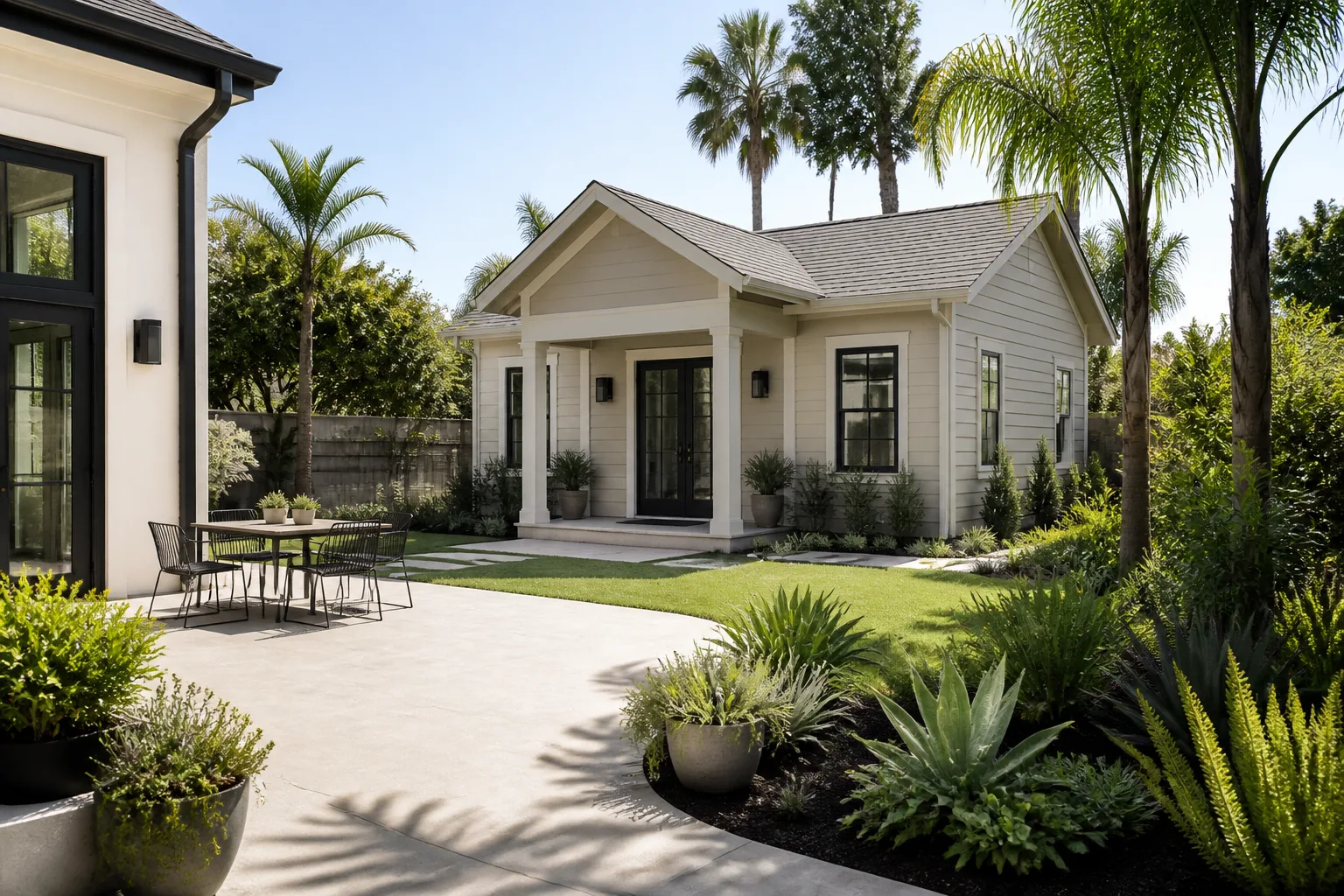
For a Plant Prefab addition in Austin, you’re looking at $45,000 – $130,000 depending on whether you’re adding a 300-square-foot bedroom suite or a full 800-square-foot ADU with a bathroom and kitchenette. At the low end, you’re getting a properly anchored, properly flashed single-room addition with one electrical circuit, finished drywall, and paint. At the high end, that’s the full ADU: kitchenette with a small appliance package, a full bath, separate HVAC mini-split, and a utility run from the main panel.
The number that moves the most in Austin is the foundation. A flat Central Austin lot with decent soil might only need a simple pier or slab-on-grade. A sloping lot in Westlake or a clay-heavy site in Round Rock needs engineering, deeper piers, or soil stabilization, and that can add $15,000 – $25,000 before the first panel arrives. Every quote from us includes the written price for foundation, panels, assembly labor, utility connections, interior finish, and the 365-Day Done Right Promise in writing. The price on day one is the price on the final invoice.
You also get our written guarantee on the work. If a seam opens or a door binds because of our install within the first year, we come back and fix it at no charge. No service call fee, no re-inspection charge, no negotiation.
DIY or Call Us?
There are things you can safely check on your own. Walk the exterior after a rain and look at the flashing at every roof-to-wall joint. Check your crawlspace, if you have one, for standing water or cracked piers after a dry spell. Look at the caulk lines around windows with a flashlight. None of that requires tools.
What you shouldn’t do is open a Plant Prefab wall panel or try to re-flash a panel seam yourself. The panel’s structural integrity depends on the factory assembly staying intact. Once you break the factory seal at the panel edge, you’ve compromised the shear strength of that wall section. If it’s a roof panel, you’re now on a roof working with height and the kind of mistake that doesn’t heal. Call us instead. We’ll come out, diagnose it properly, and give you a written price before any work starts. Call (325) 225-5429 and ask for Trevor.
FAQs
A properly installed Plant Prefab addition should last 40 – 60 years in Austin with regular maintenance, but the flashing and sealant need inspection every 5 – 7 years because Texas UV exposure shortens their effective life. The structure itself is sound; it’s the joints and transitions that need attention. Call (325) 225-5429 for an inspection and honest assessment.
Yes, in most cases the issue is localized: a failed flashing run, a binding door from foundation shift, or a single electrical circuit that’s undersized. We quote the repair only, with a written price, rather than pushing a full replacement. Call (325) 225-5429 and we’ll tell you what’s actually wrong.
Most Plant Prefab additions or ADUs we build in Austin take 10 – 20 weeks from permit to final inspection, depending on foundation complexity and the city’s review queue. The factory lead time for panels is usually the longest single wait. We’ll give you a written timeline with the quote.
We stock common jamb extensions, threshold transitions, flashing materials, and electrical panel components compatible with Plant Prefab panelized and modular builds. For model-specific factory parts, we source directly from suppliers we’ve worked with since we started serving South Congress, Allandale, and the wider Austin area. Call (325) 225-5429 for availability.
Written by Trevor Nash, Owner, Penhallow Remodeling Austin at Penhallow Remodeling Austin, serving Austin and nearby areas.


