






Free written scope consultation - allowances, timeline, and change-order rules on paper before a single trade is scheduled
Boral Home Additions & ADU: The Austin Owner’s Guide
If you’re searching for “Boral home additions & ADU” in Austin, you’ve likely hit a wall with a project that stalled, a price that shifted after demo day, or a contractor who stopped answering the phone. That’s exactly the problem Penhallow Remodeling Austin solves. Whole-home additions and accessory dwelling units (ADUs) built around Boral materials typically run $45,000 – $130,000 in Austin depending on square footage, foundation work, and whether you’re adding a standalone ADU or tying into your existing roofline. Trevor Nash and our crew have been remodeling Austin homes for well over a decade, and we put the price in writing before the first board comes off the truck.
Boral makes building products that show up all over a Texas addition: treated lumber for framing, trim boards that hold paint through Austin’s UV hammering, and siding that doesn’t warp when the humidity swings from 30% to 95% in a week. When a Boral product fails on an addition, it’s usually not the material itself. It’s the installation around it: a flashing detail that was skipped, a ledger board that wasn’t properly tied, or a joint that was never sealed against the wet-dry cycle we get in Central Texas. We see it on additions throughout the city, from South Congress to Mueller to the older stock up in Crestview.
We’re an independent Austin remodeling company. We’re not affiliated with Boral, and we don’t pretend to be. But we work with Boral products on additions and ADUs regularly, and we know the compatibility details that make the difference between a project that holds and one that fails inside two summers.
Which Boral Models This Applies To

Boral doesn’t make a single “home addition” product. What you’re likely dealing with is one of several Boral material lines used in your addition or ADU build:
- Boral TruExterior Siding & Trim: A poly-ash product that comes in lap siding, panel siding, and trim boards. Available in widths from 4″ to 12″ for trim, with siding profiles that mimic cedar lap, board-and-batten, and shingle. It cuts like wood but doesn’t swell, rot, or cup. Austin installers love it for ADUs because it holds a paint line for years without the telltale Texas fade-and-crack cycle.
- Boral Lumber (formerly Boral Treated Pine): Pressure-treated southern yellow pine for sills, plates, and framing that sits against concrete. Marked with the Boral stamp on the board face. The compatibility detail that matters here: Boral lumber is treated to a retention level that works for ground contact, but only when the cuts and notches are field-treated after cutting. Skip that step and Austin termites will find the exposed end grain.
- Boral Roofing (concrete tile and composite): If your ADU or addition has a tile roof, Boral concrete tile is a common spec. Tile profiles include flat, low-profile, and barrel. The gotcha: Boral tile dimensions don’t always match the tile you’ll find at a local Austin supplier if you’re replacing a few broken pieces. A 15″ tile from Boral isn’t interchangeable with a 15″ tile from another manufacturer without checking the interlocking geometry.
On the addition side, the question is usually whether to stay OEM with Boral products or use a quality aftermarket equivalent. Our honest position: for structural lumber and tile, we rarely see a reason to pay the Boral premium once you’re past the initial build. For TruExterior trim and siding, we recommend staying with Boral. The material’s stability is the point, and cheaper PVC or wood-composite substitutes in Austin’s heat don’t hold paint or tolerate the thermal expansion as well. If you’re matching an existing Boral siding line, stay OEM. Mixing brands on an exterior wall is how you get a stripe of faded, cracked trim two years from now.
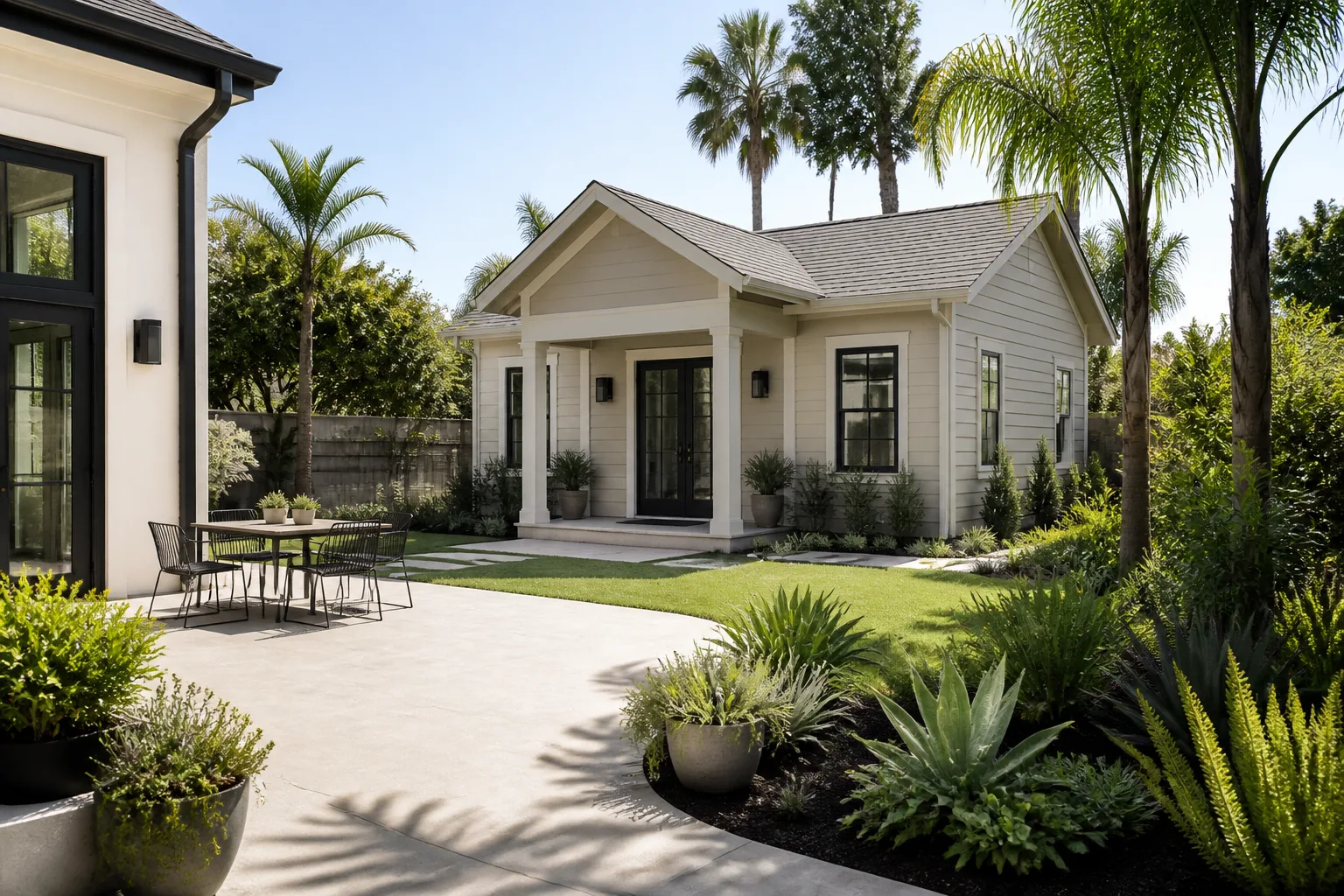
On ADUs, the same logic applies. A 600-square-foot backyard unit in Allandale or Hyde Park is usually built on a slab with Boral-treated lumber for the bottom plates and TruExterior for the trim. If that unit is showing problems, the cause is rarely the Boral material failing on its own. It’s what happened at the transitions: the point where the ADU wall meets the slab, where the roof ties into the wall, where the siding meets the window flashing. Those are the joints that leak, and in an Austin summer, a small leak becomes a mold problem fast.
If you need help identifying exactly which Boral product you’re dealing with, look for the manufacturer’s stamp on the board face, the tile backer, or the trim edge. Take a photo of the stamp and the damaged area before you call. We’ll ask for it, and it saves a trip.
Styles & brands we work with







Signs Your Boral Home Additions & ADU Is Failing
- Trim boards pulling away from the wall or cracking at the joints. This is thermal movement combined with improper fastener placement. Boral TruExterior expands and contracts more than wood, and if it was nailed too tight or too close to the edge, it splits. We see this most often on south-facing walls in Austin where afternoon sun hits hard.
- Siding that has swollen, blistered, or has paint peeling in sheets. Boral siding doesn’t absorb water the way wood does, so peeling paint is usually a sign of trapped moisture behind the siding. That means a flashing failure up above: a missing drip edge, a window that wasn’t taped correctly, or a roofline that’s shedding water directly onto the wall.
- Soft spots in the floor near exterior walls or where a room meets the slab. This is almost always the treated bottom plate rotting out. With Boral lumber, the rot is almost never the wood failing. It’s that someone notched or cut the board after treatment and skipped the field treatment, then it sat in contact with a wet sill. Austin’s clay soil holds water after rain, and it wicks right up.
- Musty smell or visible water stains in corners or where the ceiling meets the wall on the addition. Roof-to-wall transitions are the weak point in every addition. If the flashing was done wrong then sealed over, the leak can hide for years. By the time you see a stain, the framing behind it is already compromised.
- Cracks in the slab or gaps where the addition meets the original house. Austin sits on expansive clay, and every addition moves a little. The connection between old and new work should be designed to flex. If it wasn’t, you’ll see diagonal cracks at the junction, doors that stick, and drywall tape that keeps splitting. Boral materials can’t fix a foundation or framing problem, but the way they’re installed can make the symptoms visible sooner.
See the difference
 Before
 After
After Before
 After
After Before
 After
AfterReplacement Cost & What’s Included
Let’s talk real numbers for Austin.
- Full home addition (300 – 600 sq ft): $45,000 – $130,000 depending on whether it’s a simple bump-out, a second-story addition, or a ground-level room with plumbing. Kitchen and bath additions push toward the top of the range. A basic bedroom or office addition sits near the bottom.
- ADU construction (detached, 400 – 800 sq ft): $90,000 – $220,000. Austin’s ADU rules changed in recent years and now allow units up to 1,100 square feet in many residential zones, but smaller units are where most homeowners land. Site work, utility connections, and foundation costs are the swing factors.
- Garage conversion to living space: $30,000 – $80,000 depending on whether the slab is already good, whether you need a bathroom, and whether the existing structure needs structural upgrades to meet code for living space.
Every one of our quotes includes the same basics: demolition and haul-off, framing, electrical, plumbing if the space needs it, drywall, paint, trim, and the Boral or Boral-equivalent materials we specify. We write the price before we start, and that number does not change unless we agree on a change order in writing. That’s the Kingswell Way, and it’s been our standard since 2004 under the Kingswell Guarantee.
The 365-Day Done Right Promise applies to every project. If something fails on that addition or ADU inside the guarantee period, we come back and fix it at no charge. Not a re-inspection fee, not a discounted repair. Free. It’s written on every quote and every invoice.
We also source from brands that carry their own warranties alongside ours: James Hardie siding, Cambria and Silestone countertops, KraftMaid and Wellborn cabinetry, Kohler and Moen fixtures. Boral materials are part of that list when the project calls for them. The product warranty and our workmanship warranty stack.
DIY or Call Us?
There’s a honest split here, and it depends on what’s actually wrong.
You can safely check for the source of a problem yourself: look for gaps in caulk at window and door trim on your addition, check for dirt piled against the siding at grade level, and look for leaves or debris trapping water at the roofline. Those are things you can see without opening anything up, and clearing debris away from the foundation is something any Austin homeowner can do.
What you should not do is pull off trim boards, open walls, or attempt structural repairs on an addition or ADU yourself. Once you break the weather barrier, you’re exposed to whatever is behind it: possibly mold, possibly compromised framing, possibly wiring that was never done right in the first place. And if the project involves removing load-bearing framing to replace a rotted bottom plate or sister a joist, that’s a structural job that should be done by a licensed contractor with a permit. Getting it wrong means the roof doesn’t stay up, and no weekend YouTube video fixes that.
In Austin, most additions and ADUs also need a permit and inspection through the City of Austin Development Services Department. We pull permits and call for inspections on every project. It’s part of the written price, and it’s part of why our work passes inspection the first time more often than not.
Trevor’s rule applies here too: “Tell me what you need, I’ll tell you what it costs, and we’ll go from there.” Call (325) 225-5429 and tell us what’s happening with your Boral addition or ADU. We’ll ask the right questions, give you a real number, and show up when we said we would.
FAQs

A properly built addition or ADU using Boral materials should last 50 years or more in Austin, with the caveat that maintenance items like paint, caulk, and flashing will need attention every 7 – 10 years. The structure itself should outlast you. What shortens that lifespan is not the Boral product, it’s installation errors at the joints and transitions, and Austin’s freeze-thaw cycles and clay soil movement will expose those errors within the first few years. Call (325) 225-5429 if you want an honest assessment of what you’re working with.
Yes, in most cases a failing addition can be repaired without a full rebuild, and that’s usually the right call. We regularly replace rotted bottom plates, re-flash rooflines, re-tape windows, and replace damaged TruExterior boards without disturbing the rest of the structure. The repair route makes sense when the framing is mostly sound and the problem is localized. If the issues are widespread, a targeted rebuild of the affected wall or section is often less expensive than chasing repairs for years. Call (325) 225-5429 for a free estimate on the scope that makes sense for your project.
Most repairs on additions and ADUs take 3 – 10 working days depending on scope. A rotted bottom plate replacement on one wall is usually a 3 – 5 day job including the drywall and paint work to close it back up. A full ADU siding replacement can run a week or more depending on the size of the unit and whether we find additional damage once the old material comes off. We give you a written schedule along with the written price, and we show up in the window we gave you.
We keep a small working inventory of common Boral TruExterior trim profiles and treated lumber on hand in our Austin shop, but most Boral-specific materials are ordered per job to match your existing product exactly. That’s deliberate. Ordering to match means we get the dimensions, profile, and finish that align with what’s already on your house, and we don’t hand you substitutes that will look wrong in six months. We also work with KraftMaid, Cambria, and Silestone on additions that include cabinetry or countertops. Call (325) 225-5429 and we’ll verify what’s available for your project before we quote it.
Written by Trevor Nash, Owner, Penhallow Remodeling Austin at Penhallow Remodeling Austin, serving Austin and nearby areas.


